Watching Without Cooking: The Curious Disconnect at the Heart of America's Food Entertainment Boom

On any given evening, millions of Americans settle onto their sofas to watch a chef reduce a stock, debone a fish, or coax a perfect caramel from a copper pan. The production values are extraordinary. The instruction, at least nominally, is right there on screen. And yet, according to a growing body of research on American domestic behavior, those same viewers are spending measurably less time in their own kitchens than their counterparts did a generation ago.
This is the central paradox of the contemporary culinary entertainment moment: a nation more captivated than ever by the art of cooking is, by most available measures, cooking less. Understanding why — and what it means for the food industry, for public health, and for the future of gourmet programming itself — requires a willingness to look honestly at what food television has become and what it was perhaps never truly designed to be.
The Numbers Behind the Narrative
The evidence of declining home cooking engagement in the United States is not difficult to locate. Studies from food research organizations and consumer behavior analysts have tracked a sustained reduction in the time American adults spend preparing meals at home. Expenditure data from the Bureau of Labor Statistics consistently shows that spending at restaurants, takeout services, and meal delivery platforms has grown as a share of household food budgets, while spending on raw ingredients for home preparation has declined in relative terms.
Simultaneously, the appetite for culinary content — on streaming platforms, on linear television, and across digital channels — has expanded dramatically. Platforms have invested hundreds of millions of dollars in original food programming. Chef-driven series routinely appear among the most-watched documentary and lifestyle content available. Food content creators command audiences in the tens of millions across social platforms.
The coexistence of these two trends — surging viewership, declining kitchen engagement — is striking enough to warrant serious examination. The instinct within the food entertainment industry has generally been to treat the two phenomena as unrelated. There is reason to believe that instinct is mistaken.
From Instruction to Spectacle
To understand the disconnect, it is useful to trace how the dominant mode of culinary television has evolved over the past two decades. The foundational programming of the genre — think public television cooking demonstrations, early cable instructional series — was built around a pedagogical premise. The host cooked. The viewer was expected to follow. The camera served the recipe.
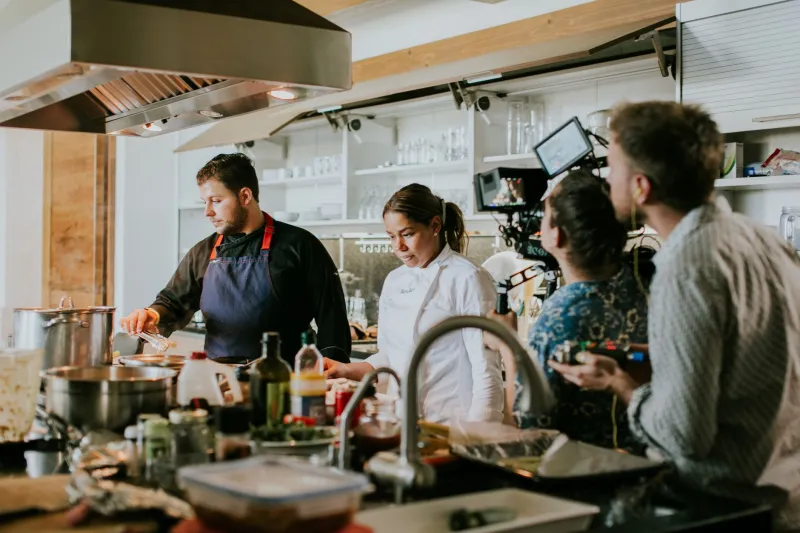
What premium culinary programming has largely become is something categorically different. The most celebrated series of the current era are not primarily instructional. They are cinematic. They deploy the language of documentary filmmaking, prestige drama, and travel journalism to construct immersive portraits of chefs, cuisines, and food cultures. The cooking that appears on screen is frequently too technically demanding, too ingredient-specific, or too equipment-dependent for any reasonable home cook to replicate. That, quite deliberately, is not the point.
The point is the experience of watching — the vicarious pleasure of witnessing mastery, the aesthetic satisfaction of beautifully photographed food, the narrative engagement of following a chef's creative journey. These are legitimate pleasures. They are also entirely separable from the act of cooking. And for a large and growing segment of the culinary entertainment audience, separation is precisely what occurs.
The Escapism Hypothesis
Several consumer researchers and food culture analysts have advanced what might be termed the escapism hypothesis: that gourmet cooking shows function, for many viewers, in roughly the same way that home renovation programming functions for people who have no intention of refinishing their own floors. The content satisfies a desire for beauty, mastery, and transformation without generating any corresponding impulse toward personal action.
If this hypothesis is correct — and the behavioral data lends it considerable support — then the food entertainment industry faces an uncomfortable question about its own cultural role. Is premium culinary programming, at its current level of sophistication and spectacle, actually discouraging home cooking by making the kitchen feel like a domain of unattainable expertise rather than an accessible creative space?
There is a meaningful difference between a program that makes cooking feel aspirational and one that makes it feel impossible. The most lavishly produced culinary series of the streaming era have, in some cases, blurred that line. When the benchmark for what cooking looks like is set by three-Michelin-starred professionals working in purpose-built kitchens with unlimited budgets and teams of skilled support staff, the domestic kitchen can feel less like a place of creative possibility and more like a site of inevitable inadequacy.
What the Food Industry Stands to Lose
The implications of sustained decline in home cooking engagement extend well beyond the entertainment industry. Producers of fresh ingredients, specialty pantry goods, and artisanal food products have long viewed culinary programming as an indirect but powerful driver of consumer behavior. When a celebrated chef features a particular grain, oil, or fermented condiment on screen, sales reliably follow.
But that relationship depends on a viewer who is, at some level, engaged with the act of cooking — someone who watches a technique and thinks, however ambitiously, about attempting it. If the dominant mode of culinary viewership shifts definitively toward passive consumption, the connective tissue between food entertainment and food purchasing behavior may weaken in ways that affect the entire supply chain.
Restaurants, delivery platforms, and prepared food brands may ultimately benefit from a population that watches cooking without doing it. The producers of the raw materials and specialty items that home cooking requires have more complex interests in the outcome.
A Path Toward Re-Engagement
None of this suggests that culinary television has failed. It has succeeded, spectacularly, at becoming compelling entertainment. The question is whether it can also recover some portion of its instructional ambition — not by abandoning cinematic quality, but by integrating it with content that genuinely invites viewers into the kitchen rather than positioning them permanently in the audience.
Some producers have begun to explore formats that bridge the gap: series that pair aspirational storytelling with genuinely accessible technique, or that frame the home cook's experience as worthy of the same respectful attention given to professional kitchens. These experiments are, for now, a minority presence in the culinary programming landscape.
Whether they represent the future of the genre or a peripheral corrective remains to be seen. What is clear is that the food entertainment industry cannot indefinitely celebrate the art of cooking while presiding over a culture that watches it rather than practices it.