Painted Hunger: The Hidden Color Science Convincing Americans They Want Food They've Never Actually Tasted
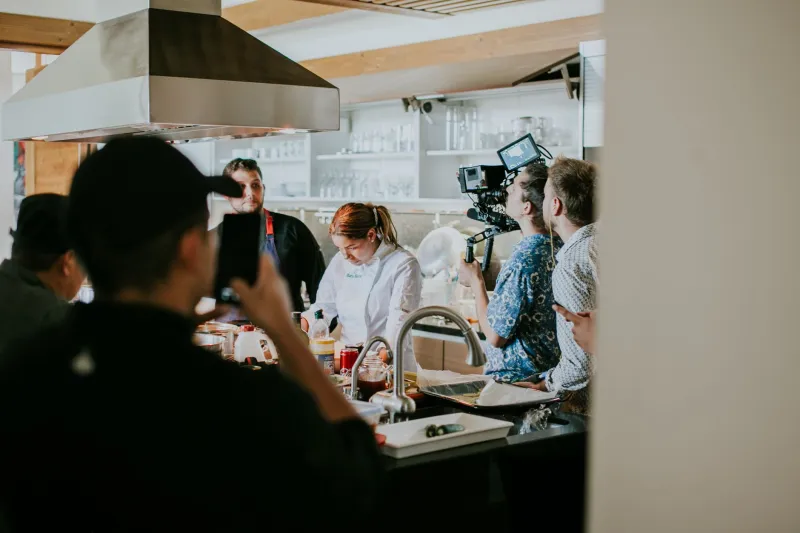
There is a moment, familiar to any devoted viewer of premium culinary programming, when a dish appears on screen and produces something close to physical longing. The crust of a roasted chicken glows with an amber so deep and even it resembles hammered bronze. A bowl of ramen steams in broth that carries the color of dark mahogany, each ingredient suspended with jewel-like clarity. A chocolate soufflé rises in a ramekin, its surface a precise shade of bittersweet that no home oven has ever quite produced.
What most viewers do not realize is that they are not, in any meaningful sense, looking at food. They are looking at a carefully constructed argument about what food should be — an argument assembled in post-production suites by colorists whose craft is largely invisible to the public and almost entirely undiscussed within the food media ecosystem.
The Grammar of the Grade
In professional television production, color grading refers to the process by which raw footage is adjusted, corrected, and stylistically shaped during post-production. For narrative film, this work is well-documented and openly celebrated — cinematographers and colorists receive awards for their contributions, and audiences have developed a general literacy around the idea that what they see on screen has been deliberately crafted.
In food television, however, this same process operates beneath the surface of public awareness. Colorists working on culinary programming routinely boost the saturation of proteins, deepen the caramelization tones of roasted vegetables, and adjust the white balance of entire sequences to push warm, appetizing tones that raw camera footage simply does not capture. The effect is not accidental. It is the product of deliberate creative decisions made in service of a single objective: to make the viewer want what they are seeing.
The challenge is that what the viewer ends up wanting does not exist outside the screen.
The Psychology of the Saturated Plate
Food psychologists have long understood that color is among the most powerful determinants of appetite and flavor perception. Research conducted at institutions including Cornell University's Food and Brand Lab has demonstrated that the visual presentation of food — including its color intensity — significantly influences not only whether people want to eat something, but how they expect it to taste before a single bite is taken.
Television colorists are, in effect, working within this psychological architecture without necessarily acknowledging that they are doing so. When a grilled salmon fillet is graded to display a more vivid orange-pink than the actual fish produced, viewers do not simply find it more visually appealing. They construct an anticipated flavor experience around that color — one that real salmon, however expertly prepared, may fail to match.
This gap between expectation and reality has a name in consumer psychology: the expectation-disconfirmation effect. And it carries consequences that extend well beyond a moment of mild disappointment at the dinner table.
Restaurant Dining in the Age of the Idealized Image
Consider the experience of the contemporary American diner arriving at a restaurant whose chef has appeared on a prominent cooking series. The diner has watched that chef prepare a signature dish under the warm, saturated visual vocabulary of premium cable or streaming production. The dish they encounter on the actual table — however skillfully executed, however genuinely delicious — exists in ordinary ambient light, on a plate that does not benefit from a colorist's touch.
Increasingly, restaurant professionals are noting a peculiar phenomenon among guests who arrive with screen-formed expectations. The dish is correct. The technique is sound. The flavor is precisely what the chef intended. Yet the guest experiences something that registers as faint deflation, a sense that the reality does not quite match the memory — even though the memory was never of reality to begin with.
Some chefs have begun responding to this dynamic by engineering plating specifically for the smartphone camera, understanding that the guest's photograph — filtered, adjusted, and posted — will become the version of the dish that most people actually see. In this way, the color-grading logic of television production has migrated into the physical dining room, reshaping presentation choices at the very source.
The Home Kitchen and the Unachievable Standard
The consequences within American home cooking may be even more significant. Culinary programming has always carried an aspirational dimension, and the genre's most devoted viewers frequently attempt to recreate what they have seen on screen. The problem is that home cooks are working against a standard that was never achievable in the first place.
A roasted vegetable medley prepared with care and appropriate technique will not emerge from a residential oven looking like its television counterpart. The colors will be accurate — which is to say, they will be somewhat muted, slightly irregular, and entirely honest. Against the memory of the graded image, they may register as failure even when they represent genuine culinary success.
This dynamic is particularly acute among younger home cooks who have grown up consuming food content across streaming platforms and social media simultaneously, absorbing an aesthetic standard built on layers of digital enhancement. For this demographic, the idealized color palette of food television is not a special effect — it is simply what good food looks like.
An Industry Conversation Long Overdue
It is worth noting that food television is far from alone in employing visual enhancement. Advertising has used food styling and post-production manipulation for decades, and the fast food industry's relationship with idealized imagery has been extensively documented and debated. What distinguishes the current moment is the scale of consumption and the intimacy of the format.
A viewer who watches a beloved chef prepare a dish across an entire episode develops a sense of trust and authenticity around what they are seeing. The enhanced color does not read as advertising — it reads as reality. That distinction matters enormously when considering the psychological weight of the resulting expectations.
A productive conversation within the culinary media industry might begin with greater transparency about the production processes that shape what viewers see. Some documentary-style food programs have moved toward a more naturalistic visual treatment, and the critical reception of these programs suggests that audiences are capable of appreciating — and indeed preferring — a less constructed aesthetic when given the choice.
What the Screen Owes the Plate
The culinary arts have always existed in an uneasy relationship with representation. A dish is a temporal, sensory experience that resists capture by any two-dimensional medium. Photography, film, and television have each developed their own conventions for approximating that experience, and none has succeeded entirely.
What the current era demands, however, is a degree of self-awareness about the distance between approximation and manipulation — and about who bears the cost when that distance becomes too great. If food television's visual language is actively reshaping what Americans believe they want, what they expect from restaurants, and what they judge as success in their own kitchens, then the industry has an obligation to examine that influence with the same sophistication it brings to every other aspect of its craft.
The food on the screen was always going to be different from the food on the plate. The question is how different we are prepared to let it become.