The Names That Never Appear in the Credits: Inside the World of Culinary Consulting for Television
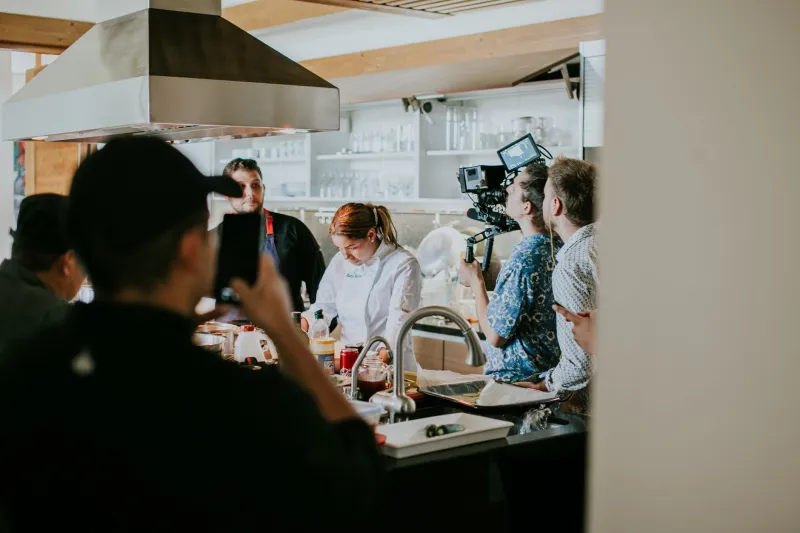
When a celebrated chef demonstrates a regional French braise on a premium cooking series, the camera follows her hands, her voice, her charisma. The dish she prepares has been tested — often dozens of times — by someone the viewer will never see. The historical context she offers for the recipe's origins has been researched and verified by someone who will not be named in the episode. The selection of that particular dish, from that particular region, as representative of that particular culinary tradition, was a decision shaped by a consultant whose contract explicitly limits her public profile.
This is not an anomaly. It is, by the account of multiple culinary professionals who have worked in the industry, standard practice.
The world of culinary consulting for television is populated by food historians, recipe developers, technique specialists, and cultural advisors whose contributions are foundational to the programming that American audiences consume as the work of the chefs they see on screen. The gap between what these consultants do and how they are acknowledged — or not acknowledged — raises questions that the gourmet television industry has been largely unwilling to address publicly.
What Culinary Consultants Actually Do
The scope of culinary consulting work varies considerably depending on the format and ambition of a given production, but certain functions recur across the industry with enough consistency to describe a general professional role.
At the developmental stage, culinary consultants are frequently involved in shaping the conceptual architecture of a series. They may research the historical and regional context for a show's culinary focus, identify the dishes and techniques that will be most representative, and assess whether the proposed on-screen talent has the depth of knowledge to present the material credibly. This last function is delicate, and those who perform it are understandably reluctant to describe it in detail.
During production, recipe developers work through the testing process that transforms a chef's instinctive approach into a reproducible, camera-ready demonstration. A dish that a professional chef executes through decades of muscle memory and sensory judgment must be translated into a sequence of steps that will read clearly on screen and produce consistent results when attempted by home cooks. This translation work is painstaking, and it is rarely the chef who performs it.
Food historians and cultural advisors contribute a different kind of labor: the research that allows a show to make accurate, defensible claims about the provenance and context of what is being cooked. When a series presents a recipe as traditional, or as representative of a specific regional identity, someone has done the work of establishing that claim. That someone is rarely the person presenting the recipe to the camera.
The Credit Question
The question of how culinary consultants are credited — or not — is one that produces a range of responses within the industry, few of them entirely comfortable.
Production companies typically argue that consultants are contracted professionals whose compensation reflects an understanding that their work will be attributed to the production rather than to themselves individually. This is, from a strictly contractual standpoint, accurate. It is also, from the perspective of professional recognition and career development, consequential.
For food historians and cultural advisors, in particular, the lack of on-screen or promotional credit can have real professional costs. Academic and institutional recognition in these fields is partly built on public attribution. A food historian who spends six months researching the culinary traditions of a specific region for a major streaming series, and whose research shapes the intellectual content of that series in fundamental ways, derives essentially no professional benefit from that work in terms of public visibility.
Recipe developers occupy a somewhat different position. The food media industry has, over time, developed a somewhat more explicit acknowledgment of recipe development as a distinct professional skill — food magazines and cookbook publishers have long credited recipe developers and testers. Television has been slower to adopt similar conventions, and the reasons for this lag are not entirely clear.
The Structural Incentives for Invisibility
To understand why the gourmet television industry has structured itself to minimize the visibility of culinary consultants, it is useful to consider what that invisibility serves.
The celebrity chef model, which has been the dominant commercial logic of food television for at least three decades, depends on the perception that the on-screen talent is the primary creative intelligence behind what is being shown. The chef's brand — her aesthetic, her philosophy, her authority — is the product being sold to networks, to advertisers, and to viewers. That brand is diluted, at least in theory, by any acknowledgment that the intellectual content of her show was substantially shaped by people who are not her.
This is not a dynamic unique to food television. It exists across entertainment industries where individual creative talent is the commercial unit. But the food world has a particular investment in the myth of the self-sufficient culinary genius — the chef who carries all of the tradition, technique, and inspiration within herself — that makes the collaborative reality of television production especially difficult to acknowledge.
There is also a competitive dimension. Culinary consultants who have developed specialized expertise — in the food traditions of a particular culture, in the history of a specific technique, in the science of a given cooking process — represent a form of intellectual capital that productions are not eager to share publicly with competitors.
Toward a Different Model
A handful of productions have begun to experiment with more transparent crediting practices, including extended credits that name recipe developers and cultural consultants, supplementary digital content that introduces viewers to the research and testing processes behind the show, and promotional materials that acknowledge the collaborative nature of the work.
These experiments are instructive, and the response from audiences has been largely positive. Viewers who are serious about food tend to be genuinely interested in the intellectual infrastructure behind the programming they consume. Knowing that a series on regional Mexican cuisine was developed in consultation with a food historian who spent years documenting the culinary traditions of Oaxaca does not diminish the authority of the on-screen chef — it deepens the viewer's confidence in the content.
The gourmet television industry prides itself on celebrating craft, on honoring the labor and knowledge that go into the creation of exceptional food. Extending that same honoring to the professionals who shape what appears on screen would be, at minimum, a consistent application of its own stated values. That it has not yet done so consistently is a contradiction worth examining — and one that the industry's most thoughtful voices are beginning, carefully, to name.