Less Is More: How Bare-Bones Food Productions Are Outperforming Big-Budget Culinary Television

Photo: Internet Archive Book Images, No restrictions, via Wikimedia Commons
There is a particular kind of silence that settles over a small kitchen when a single camera is rolling and no director is calling out adjustments from across a cavernous studio floor. It is the silence of genuine concentration. And increasingly, American audiences are finding that silence—and the intimacy it carries—far more compelling than the orchestrated spectacle of network food television.
The data, while still emerging, points in a consistent direction. Independent culinary productions operating on a fraction of the budgets commanded by major network shows are generating engagement metrics—measured in completion rates, social shares, and repeat viewership—that their better-financed competitors struggle to match. The question worth asking is not merely whether this phenomenon is real, but why it is happening and what it reveals about the evolving relationship between food, storytelling, and the screen.
The Weight of the Camera
When a production team numbers in the dozens and a shooting schedule spans several weeks, something almost inevitable occurs: the chef becomes a performer. The kitchen becomes a set. The food becomes a prop. These are not accusations but observations shared openly by independent producers who have worked on both ends of the budget spectrum.
"The moment you bring in a full lighting grid and a team of food stylists, you've already made a decision about what kind of show you're making," says one independent producer based in Portland, Oregon, who has spent the last several years developing single-chef documentary series for streaming platforms. "You're making a show about perfection. And perfection, it turns out, is not what people are hungry for."
This observation speaks to something fundamental about what food means in American culture right now. After years of aspirational programming that positioned haute cuisine as a distant ideal, viewers appear to have recalibrated their expectations—and their desires. The cooking show that resonates today is less likely to feature a gleaming test kitchen and more likely to unfold in a cramped apartment, a family-run restaurant, or a rural farmhouse where the lighting is whatever the afternoon sun provides.
Constraint as Creative Catalyst
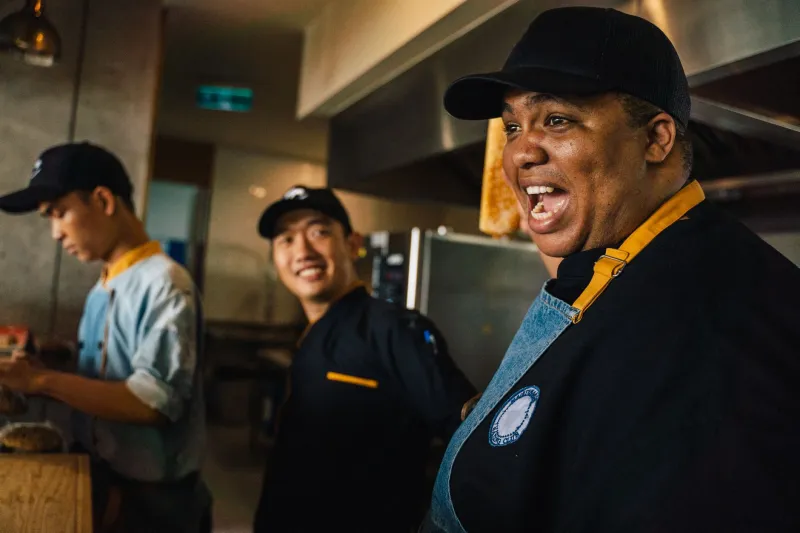
The technical choices forced upon low-budget productions—choices that might initially appear to be disadvantages—often function as creative accelerants. A single fixed camera cannot cut away from an awkward pause or a culinary misstep. A minimal crew means that a chef who burns a sauce must address it on camera rather than retreating behind an edit. These moments of unscripted reality become, paradoxically, the moments viewers remember most vividly.
Independent producers frequently describe a process of creative problem-solving that larger productions simply do not require. When you cannot afford elaborate motion rigs, you develop an instinct for static framing that emphasizes texture and depth. When you cannot hire a dedicated sound engineer, you learn to use ambient kitchen noise—the hiss of oil in a pan, the rhythmic knock of a knife on a cutting board—as an emotional score in its own right.
This resourcefulness extends to narrative structure as well. Without the budget to sustain a multi-location story arc across a season, small productions tend to invest more deeply in a single subject, a single relationship, or a single culinary tradition. The result is programming that feels less like a tour and more like a portrait.
What Viewers Are Actually Responding To
Engagement analysts who track streaming behavior across culinary content categories have noted a consistent pattern: viewers of lower-budget productions tend to watch longer, return more frequently, and express stronger brand affinity for the shows they discover. The working hypothesis among content strategists is that perceived authenticity functions as a form of trust, and trust is what sustains a viewership relationship over time.
This is not simply a matter of aesthetic preference. American audiences have become remarkably sophisticated consumers of visual media, and many are now capable of detecting the invisible architecture of a heavily produced show—the too-perfect mise en place, the strategically placed splatter of sauce, the chef who somehow never appears to sweat. When that architecture is absent, when the production refuses to perform its own competence, something shifts in the viewer's posture. They lean in rather than sit back.
Social media amplification plays a role as well. A single unguarded moment—a chef tasting something that doesn't work and laughing about it, a forgotten ingredient retrieved from the back of a pantry shelf—generates the kind of shareable content that no marketing team can manufacture. These moments travel because they feel true, and they feel true because the production environment that created them did not have the resources to engineer them away.
The Economics of Emotional Resonance
For network executives accustomed to measuring value in production values, the success of constraint-driven food television presents a genuine strategic challenge. The assumption that higher investment correlates with higher quality—and therefore higher ratings—is not easily abandoned, particularly within institutional cultures that have been organized around it for decades.
Yet the independent production community is beginning to offer a compelling counter-argument, not just in aesthetic terms but in financial ones. A series produced for a fraction of the cost of a flagship network show, and generating comparable or superior engagement, represents a fundamentally different kind of return on investment. Streaming platforms, several of which have begun actively courting independent culinary producers, appear to be doing this math with increasing seriousness.
The implications for the broader food television landscape are significant. If emotional resonance—the quality that makes a viewer feel genuinely connected to what they are watching—is more reliably produced by constraint than by abundance, then the entire logic of premium culinary production may require reexamination.
The Future of the Intimate Frame
None of this suggests that big-budget food television is destined for obsolescence. The spectacle of a perfectly orchestrated multi-course tasting menu, rendered in cinematic detail, still commands an audience and still serves a genuine cultural function. There will always be viewers who come to culinary programming for aspiration, for the vicarious pleasure of witnessing mastery at its most polished.
But alongside that tradition, something new and durable appears to be taking root. A mode of food television that trusts the camera to find meaning in the unadorned moment—in the chef who pauses before plating to taste one more time, in the kitchen that bears the honest marks of actual use—is earning a loyalty that its more elaborate counterparts are finding difficult to replicate.
The intimacy that small budgets produce is not an accident of poverty. It is, increasingly, a creative philosophy. And the audiences who have discovered it show little inclination to trade it back for gloss.