When Instinct Leaves the Kitchen: How Gourmet Television's Worship of Mise en Place Is Quietly Killing Culinary Intuition
There is a particular kind of beauty in watching a professional kitchen organized to perfection. Ingredients sorted into small white bowls. Herbs stripped and aligned. Proteins portioned and labeled. Gourmet television has made this image iconic — the visual shorthand for seriousness, discipline, and culinary competence. Yet a growing number of working chefs across the United States are raising an uncomfortable question: has the camera's love affair with mise en place come at the cost of something far more essential to great cooking?
The answer, many argue, is yes — and the consequences extend well beyond the screen.
The Camera's Comfortable Lie
Mise en place, the French term for "everything in its place," is a foundational principle of professional cooking. No serious chef disputes its importance. The trouble, according to veterans of both restaurant kitchens and television productions, is not the practice itself but the meaning the medium has assigned to it.
On screen, mise en place is presented as the destination rather than the departure point. Viewers are shown immaculate arrangements of pre-measured components and invited to interpret this organization as the essence of culinary skill. The message, delivered week after week across dozens of cooking programs, is quietly but unmistakably clear: mastery is a matter of preparation, and preparation is a matter of precision.
Chef Marcus Ellroy, who has helmed two James Beard Award-nominated restaurants in Chicago and briefly consulted on a premium food network series, describes this framing as a fundamental distortion. "What you see in those little bowls is the beginning of cooking, not the heart of it," he said in a recent conversation. "The moment the heat goes on and things start changing — that's where real skill lives. And that part is almost impossible to communicate on television because it happens in fractions of a second, in the nose, in the fingertips."
The camera, in other words, can capture order. It struggles profoundly with instinct.
Precision as Performance
The rise of competition-format cooking programs has intensified this dynamic considerably. When contestants are judged under strict time constraints and evaluated by criteria that reward consistency and technical replication, improvisation becomes a liability rather than an asset. Producers, understandably, gravitate toward formats that generate visual clarity and narrative tension — and a cook who pauses to taste, recalibrate, and redirect mid-preparation does not always make for compelling television.
What does make for compelling television, reliably, is the beautifully arranged station. The organized mind made visible. The mise en place as metaphor for control.
Several chefs interviewed for this piece noted a troubling feedback loop emerging from this representational choice. Young cooks who have grown up watching premium culinary programming arrive in professional kitchens with an almost liturgical attachment to exact measurements and pre-set arrangements — but a diminished capacity to respond dynamically when circumstances shift, as they inevitably do in any real service environment.
"I had a line cook last year who could break down a recipe into perfect mise en place faster than anyone I'd ever seen," recalled Chef Diane Okafor, owner of a celebrated New American restaurant in Nashville. "But when a delivery came in short and we had to pivot on a sauce mid-service, she froze. The script wasn't there. The little bowls weren't there. And she genuinely didn't know what to do."
The Senses That Don't Photograph
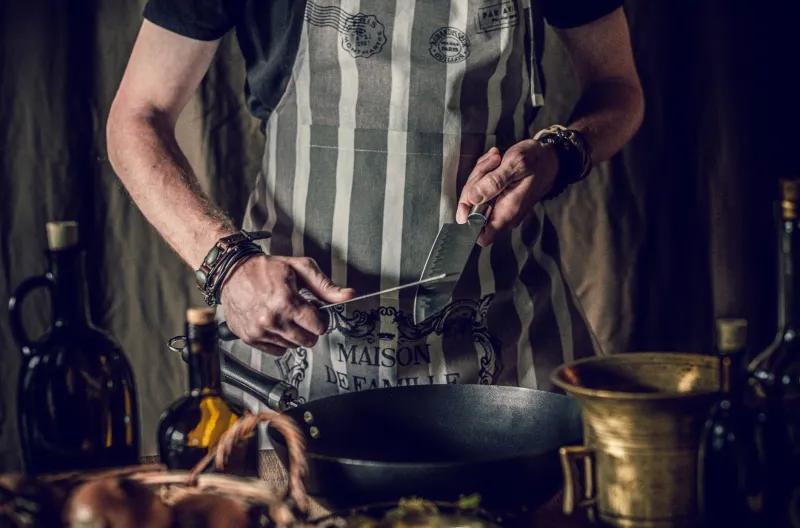
At the core of this issue lies a fundamental incompatibility between the medium of television and the sensory reality of cooking at the highest level. Great chefs routinely describe their decision-making in terms that are almost impossible to visualize: the way a sauce smells when it needs acid, the sound a sear makes when the pan is at precisely the right temperature, the feel of dough that tells an experienced baker it needs another thirty seconds of work.
These are not skills that can be arranged in a ramekin. They cannot be lit dramatically or captured in slow motion. They exist in the body, accumulated through years of repetitive, attentive practice — and they are, by their nature, resistant to the grammar of visual storytelling.
Gourmet television, to its credit, has occasionally attempted to address this gap. Some of the medium's more ambitious productions have incorporated narration from chefs describing their internal reasoning in real time, or have used close-up audio to communicate the sensory cues that guide professional decisions. But these remain exceptions in a landscape dominated by visual spectacle, and they rarely achieve the intimacy necessary to convey what experienced cooks mean when they speak about cooking by feel.
"You can show someone how to hold a knife," said Chef Tomás Rivera, a culinary instructor at a prominent San Francisco cooking school who has appeared on several regional food programs. "You cannot show them how a knife starts to feel right after ten thousand repetitions. That knowledge doesn't exist on the surface of things. Television only has access to the surface."
Reclaiming the Unrehearsed Kitchen
This is not, it should be emphasized, an argument against mise en place as a professional practice. Organization, precision, and disciplined preparation remain indispensable to serious cooking. The critique is narrower and more specific: it is directed at the way gourmet television has transformed a preparatory tool into a representational ideal, and in doing so has quietly reshaped public understanding of what culinary excellence actually requires.
Some producers and content creators are beginning to push back. A handful of independent streaming productions have experimented with less structured formats — following chefs through unscripted market visits, capturing the spontaneous decisions that arise when a planned dish must be reconceived on the fly, or simply allowing extended, unedited sequences of cooking that permit viewers to observe the rhythm of intuitive adjustment. The reception among dedicated food audiences has been notably warm.
There is, it seems, an appetite for the unrehearsed kitchen — for programming that trusts viewers to find meaning in the messy, instinctive, deeply human process of cooking without a predetermined script.
What the Screen Owes the Craft
Gourmet television, at its finest, has always aspired to more than instruction. The medium's most enduring programs have managed to communicate something of the philosophy, the obsession, and the deeply personal vision that animates extraordinary cooking. That ambition is worth preserving — and worth protecting from the comfortable reductions that ratings pressures and production conventions tend to impose.
If the industry is serious about honoring culinary craft rather than merely illustrating it, the conversation about mise en place deserves a prominent place in that reckoning. The little bowls are beautiful. They are also, by themselves, not enough.
The intuition that separates a competent cook from a genuinely great one was never going to fit neatly inside them — and gourmet television will serve its audience best when it finds the courage to say so plainly.